
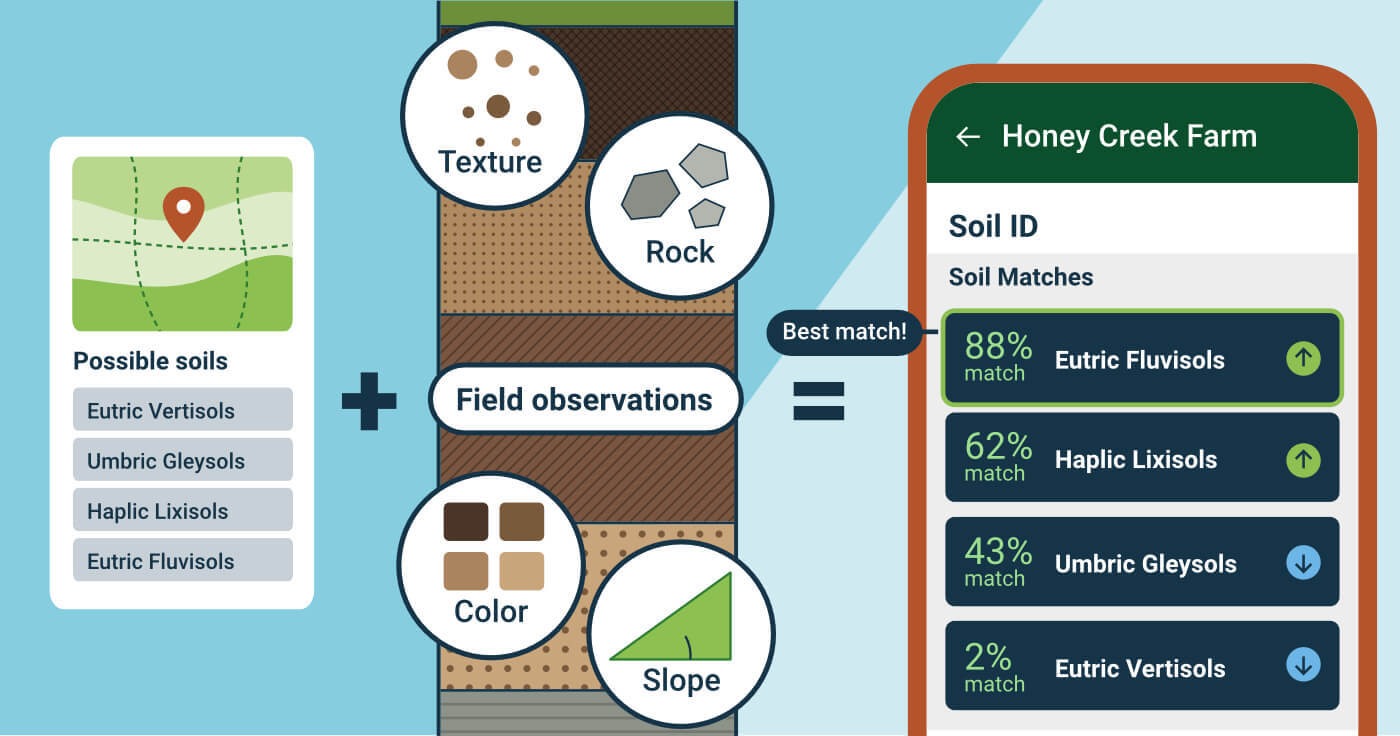
We’ve just released LandPKS Soil ID 1.4.8, and it provides more accurate soil identification. This update changes how the Soil ID algorithm scores your observations — slope, texture, rock fragment volume, and color — so the ranking of possible soils better reflects what is actually in the ground. It also fixes bugs that could hide a site’s elevation or get in the way of creating a site from a temporary location, and makes toggle switches in the user interface consistent and more accessible regardless of which device you use. Download the latest LandPKS Soil ID for Android and iOS now!
More accurate soil identification from your observations
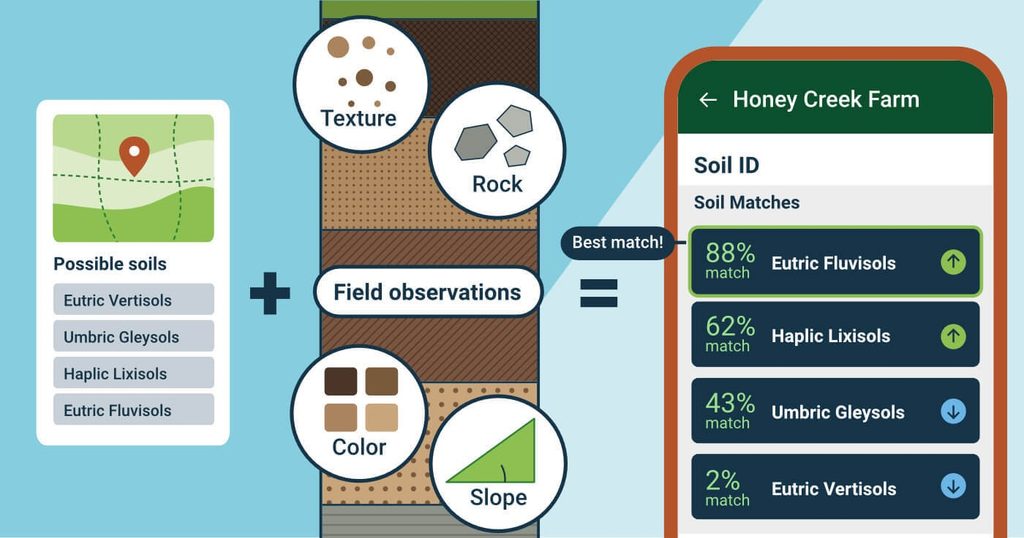
LandPKS Soil ID compares the soil properties you observe with data from soil maps to rank the soil most likely to be at your site. Version 1.4.8 improves how that comparison is scored in four ways:
- Rock fragments, measured more finely. Soils on soil maps include a measured percentage of rock fragments. The algorithm now compares against that measured value directly instead of rounding it to the middle of a broad category, so it can differentiate between soils that were previously treated as identical.
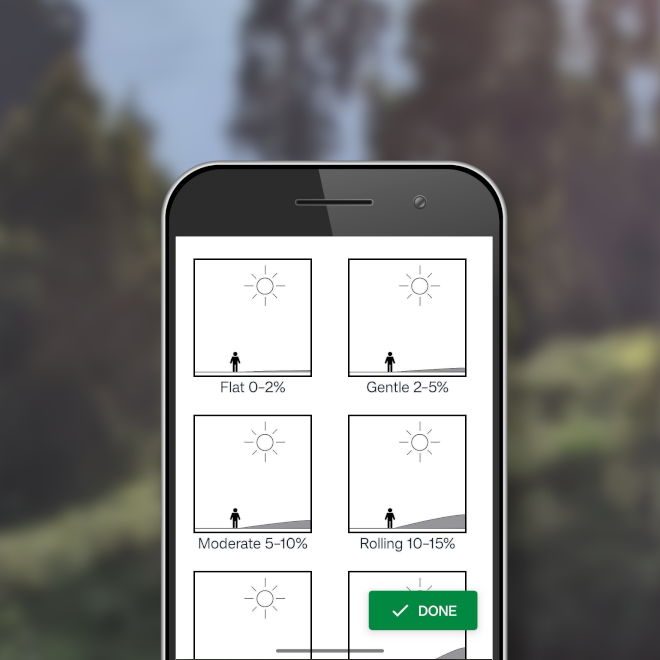
- Slope, read the way you meant it. For people who use slope steepness pictographs, the algorithm now uses the middle of that category’s range instead of its lowest edge. For example, a “hilly” slope (15% to 30%) is now treated as roughly 22%, not 15%.
- Your observations count for more. Landscape features like slope and elevation were outweighing the soil properties you observe directly at each depth. We rebalanced the score so that what you see and feel in the pit has more influence on the ranking.
- More predictable match scores: the Soil ID algorithm now compares your observations against each soil possibility in isolation, rather than factoring in the properties of other potential soils at that depth.
This last change is subtle, but we think it is a big improvement. We originally developed the algorithm to consider the variance between the nearby possible soils, so each observation could impact a soil’s match score differently depending on the variability of those soil candidates. It was a little like using relative scoring in a classroom test, where each answer impacted the score of an individual soil match differently depending on how other possible matches in the “class” performed. Among people we showed the tool, and even among ourselves, it made explaining the impact of each observation a little challenging.
We tried an alternative approach where the Soil ID algorithm evaluated each soil by itself, without considering the properties of other possible matches. In effect, we removed the curve from our scoring rubric for each soil’s “exam”. Through testing thousands of cases, we found that a direct comparison is on average just as accurate: many soil match scores changed while rankings largely stayed the same, and at the same time each observation’s impact on the soil’s score became more predictable.
For the curious: we test every scoring change against a dataset containing thousands of soils whose identities were determined by a soil scientist. After these changes, a test of our U.S. soils found the right soil appeared in the top 5 of the match list 91% of the time, an improvement of 8.2%! We have more data about the outputs of the algorithm and will provide a detailed analysis soon.
Fixes and polish
A few other changes to the app in this release:
Automatic score updates: Moving forward soil match scores will be refreshed automatically whenever we improve the algorithm, so you will always see results from the latest version of the soil ID service without having to update or restart the app.
Elevation, found more reliably. A bug sometimes left a site without an elevation. Elevation now comes from the same reliable source the algorithm uses when ranking soils, so it is delivered more consistently and always matches the value used to calculate your soil match score.
Creating sites from a temporary location. We fixed a bug that prevented people from quickly accessing their site if it was made while exploring soil ID matches. That flow now works reliably.
Consistent switches you can trust. We rebuilt the on-off switches used throughout the app to look and behave the same on Android and iOS, with clearer visibility. Switches now also announce their state and purpose to screen reader users. And we fixed a bug where a required observation method could display as “on” while saving as “off” — now what you see on the screen is what gets saved.
Get involved
For a full list of improvements to LandPKS Soil ID, please view our changelog. If you have a request for how we can make LandPKS more useful to you, please contact us. Join our beta program to get the first look at new features.

